by Nellie Curtiss …
Isn’t it time we value our children and families more than we value the gun lobby?
Matthew McConaughey’s hometown is Uvalde, Tx. The day of the Robb Elementary massacre in Uvalde, he asked us on Facebook, “The true call to action now is for every American to take a longer and deeper look in the mirror, and ask ourselves, “What is it that we truly value? How do we repair the problem? What small sacrifices can we individually take today, to preserve a healthier and safer nation, state, and neighborhood tomorrow?” We cannot exhale once again, make excuses, and accept these tragic realities as the status quo.”
The star of Sahara (2005), Lincoln Lawyer (2011) and Free State of Jones (2017) goes on to say, “As Americans, Texans, mothers and fathers, it’s time we re-evaluate, and renegotiate our wants from our needs. We have to rearrange our values and find a common ground above this devastating American reality that has tragically become our children’s issue. This is an epidemic we can control, and whichever side of the aisle we may stand on, we all know we can do better. We must do better. Action must be taken so that no parent has to experience what the parents in Uvalde and the others before them have endured.”
Ten years ago, the National Academies Press (National Academies of Science, Medicine, and Engineering with the National Research Council) published Contagion of Violence: Workshop Summary (2012). In this work, researchers learned that violence acts like any contagion or epidemic. Violence is contagious and addressing the issues of gun violence might very well benefit from a plan similar to preventing the spread of illnesses. Perhaps, McConaughey is right that it is a controllable epidemic, and we must take action.
In essence Dr. Gary Slutkin would agree with McConaughey and does argue in his paper Violence is a Contagious Disease or Cure Violence that like diseases that cluster, spread and transmit, violence also clusters, spreads and transmits. He sums up, “In infectious disease language it means simply that being exposed to the disease makes it more likely that you will also develop the symptom complex characteristic of the same disease. This phenomenon has been shown for violence through many studies: people who are exposed to violence—either by observing, witnessing, or being subjected to violence themselves—are more likely to become what is called a perpetrator of violence.” He also argues that the cure is similar to curing any disease.
In a 2018 Guardian article, Slutkin again urges, “Understanding violence as a contagious health problem means using a basic set of epidemic control methods to prevent spread, including a) community violence interruption, b) outreach and behavior change with those at highest risk, and c) public education and community mobilization to shift social norms.”
Everyone saw this played out in this Covid-19 pandemic that we are still navigating. Isolating interrupted the spread of the variants, changing public behaviors slowed the progress, and educating the public on the science of the Covid-19 virus and variants also shifted our public norms. A new norm, mask wearing, although lessened publicly, continues in hospitals and clinics. Thus, researchers on violence are saying we can make these changes regarding the spread of violent acts like recent school shootings.
Explaining, Slutkin says, “Despite the progress, violence remains an unmanaged health epidemic in many communities, and nearly all of the persons suffering from high exposure to violence go completely untreated and unsupported.”
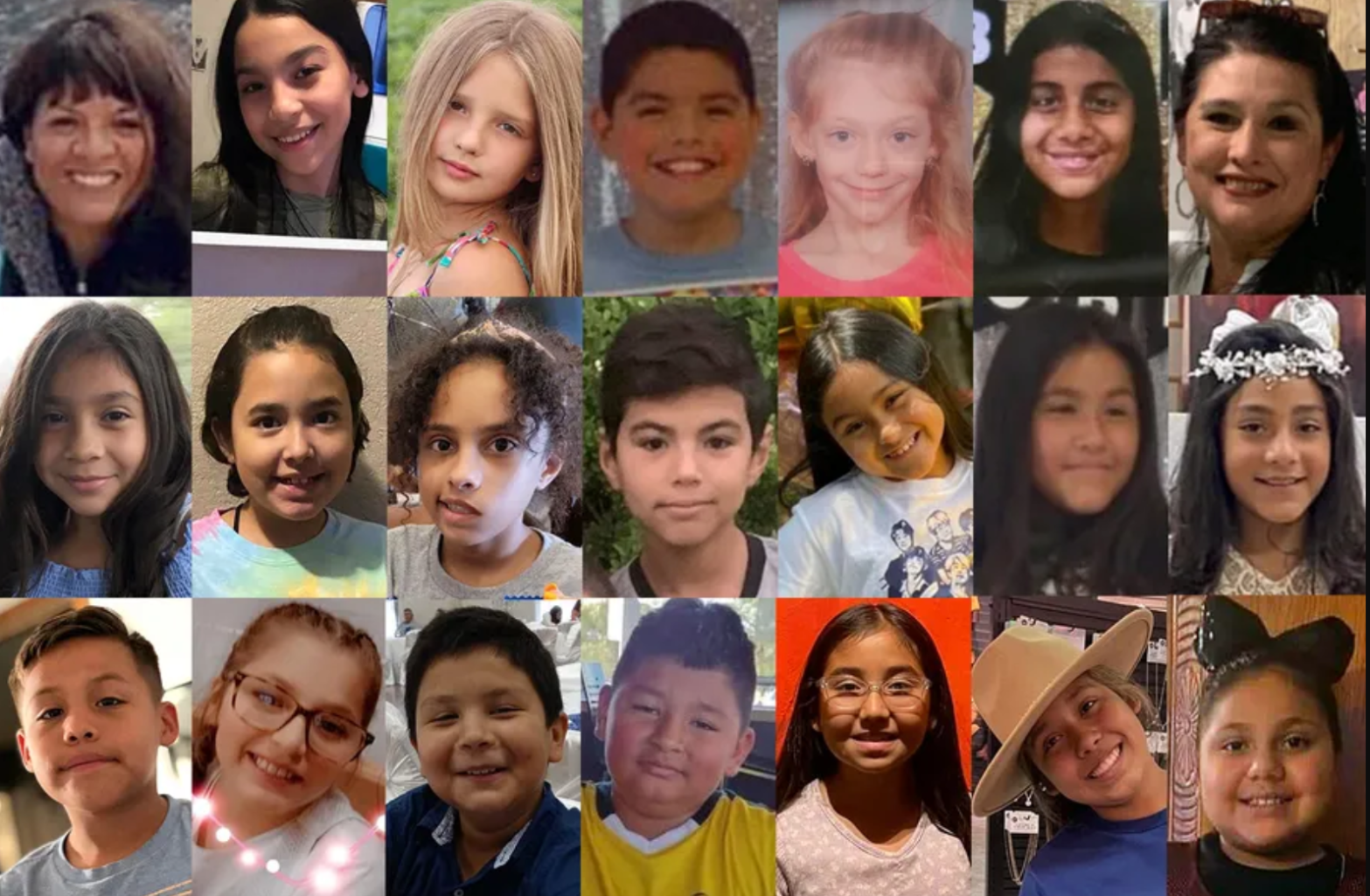
As yet another umpteenth wake-up-to the-violence call, the war-gun toting teen murdered innocent 2nd, 3rd, and 4th graders wrapping up the school year at Robb Elementary of Uvalde, Texas. This violent event demands that we change our norms away from ignoring violence to exposing the violence and interrupting the violence with treatments like red flag warnings, eliminating non-combat purchases of all war guns and automatic rifles, providing therapies to trauma victims, and offering alternatives to violence like expression through the fine arts: music, theater, art. By changing our norms from valuing guns to valuing children, we can interrupt the course of viciousness in favor of peace via policy that removes high-capacity magazine guns from shelves, that makes policies around safe ownership of guns, that gets more mental health avenues out there for people. Let’s all encourage each other to reach out for help, to revisit policy around guns, and to reconsider who matters to us.
Uvalde native, McConaughey shared his final thought that silently beckons us to change policy for the good of our children: “And to those who dropped off their loved ones today not knowing it was goodbye, no words can comprehend or heal your loss, but if prayers can provide comfort, we will keep them coming.”
Nelda Curtiss is a retired college educator and long-time local columnist. Reach her at http://www.columnsbynellie.com or email her at columnsbynellie@gmail.com
 Columns by nellie