By Nellie Curtiss …
Halloween night as you listen for unexplained shuffling of shoes against a hard-wood floor, or watch for flickering lights already switched off, and find doors ajar that were locked, remember whiskey, mayhem, and a friendly ghost. The Halloween winds are walking again at Fort Garland’s infantry building where Pvt. Manuel Lujan from a New Mexico regiment was murdered by Homobono Carbajal near dawn on May 21, 1863.
His ghost shadows the adobe walls, the antique wood, the authentic furniture, circa 1858. Visitors have “felt and sensed something or someone” in that building, said Josie Lobato, former Fort Garland Museum administrator from 1984-1997. Once after scouting the infantry building and grounds, a Sioux Medicine Man announced, “Did you know that you have a ghost?” Lobato said.
One woman came to me with her face “pale and white as if she had seen something.” The scared woman told Lobato that when she sat down on the bench beside the infantry doorway, she felt someone touch her leg. “That was the worst report I had,” Lobato said about the then unidentified ghost.
Lobato, like Rick Manzanares Museum (former) Director, Fort Garland Museum, find lights turned on that were toggled off, and doors unlocked that were locked the evening before. “It’s not a mean spirit,” Manzanares says. Lobato learned the ghost’s identity in March 1993 when the Denver Historical Society Volunteer, Donald J. Carlisle, uncovered a murder in the very building of the hauntings.
Wanting to find out for herself, she read the microfilm purchased from the military, and read about the “death of Manuel Lujan” in a report.
J.C. Davidson, Captain, Commanding, Fort Garland wrote “From what little I can learn of the case, it was caused by whiskey.” He notes alcohol was bought on “payday” from “whiskey peddlers along the creeks.” “…the men would go there after Tattoo and get good and drunk.”
“And it seems that those two men, while at one of these drunks had a quarrel. When they came home, one of them was put in the guard house and they have not been together since, until this morning when Lujan was released and went into his quarters to sleep.”
“The other man killed him,” Davidson reports.
Lobato’s research showed that Lujan was released at 2 a.m. and about 5 a.m. Carbajal was released. Carbajal immediately entered Lujan’s squad room. Carbajal fired once point blank into the back of Lujan’s head.
Manzanares said that Carbajal never served out a sentence. Although he was due to be hanged, he wasn’t because “he was crazy” or because of “temporary insanity,” by order of J.M. Chivington, Colonel, 1st Calvary of Colorado Commanding District. Chivington was a hero here, but later he was a villain at the Sand Creek Massacre, Manzanares said.
Supposing that Manuel Lujan’s ghost is “seeking justice,” Lobato and Manzanares have employed the ghost as guard, and so have made friends with a friendly ghost. “I’m not taking chances,” Manzanares added.
“Perhaps they fought about a woman, whiskey, or gambling,” Manzanares said. What is clear, he added, is that the white people originally investigating the murder didn’t know Spanish, both Lujan and Carbajal spoke Spanish. The investigation was very piecemeal, he said.
Manzanares has called upon Lobato for help when “things were difficult,” Lobato said. Manzanares decided early on with his encounters with open doors, lights on, and reports from visitors to say Rosary in the infantry building. Then following the lead of Lobato who would speak Spanish to the ghost, Manzanares puts the ghost on guard duty: “Buenas Noches, Senor Manuel, cuide el lugar esta noche por favor.” In English, “Take care of the place; it is yours for the night.”
Lobato felt comfortable and safe in the infantry building. As she decorated the sergeant’s room from authentic furniture out of La Junta, she thought maybe the ghost will like the cup, the cot, the table. She knew he was Hispanic and spoke his language. She gave him guard duty as well: “Bueno Manuel. Esta en guardia.” In English, “Ok Manuel, You’re on guard duty.”
About 1993 when Lobato was first learning through the military microfilm about Manuel Lujan, a female visitor “claimed to me that she had been in the infantry barracks and had seen a soldier shot.”
Verna Cordova, employee at Fort Garland Museum, said that she has “heard noises in that building, the infantry barracks, like feet dragging; but maybe I scare myself too much.” Continuing her account, Cordova said, “A counselor or a nurse that was here with a youth camp from July 29 to August 25, 2000, said she had not slept all night. She was pretty sure that it was a ghost because there was no one there at the time.”
Lobato also recalls one summer when there was a rash of burglaries in the Fort Garland-Blanca area. She put Manuel on guard duty and locked up for the night. There was a break in overnight by probably some young people, she said. When the sheriff arrived, he said the elk horns on the floor next to the window, the footprints outside the broken window suggested that whoever had broken in left in an awful hurry. Lobato suspects that Manuel took his guard duty serious. The youngsters never returned to burglarize Fort Garland.
“I don’t need a burglar alarm; Manuel is my alarm,” she said to herself.
Likewise, Manzanares tells visiting youngsters and families, “Most museums have security guards; our ghost is our only guard.”
“I don’t know whether or not I believe in the ghost; you might not either; it’s your choice.” But you can be sure that Manzanares and his staff are not taking chances tonight. “Buenos Noche Manuel. Esta en guardia.”
— Nelda Curtiss is a retired college educator and long-time local columnist. Reach her at http://www.columnsbynellie.com or email her at columnsbynellie@columnsbynellie
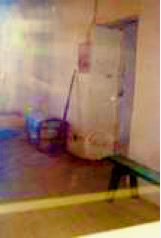
About the photo:
Rick Manzanares, Museum Director, Fort Garland Museum, addresses Pvt. Manuel Lujan’s ghost putting him on guard duty: “Buenas Noches, Senor Manuel, cuide el lugar esta noche por favor.” In English, “Take care of the place; it is yours for the night.” Behind Manzanares is a door that is often found ajar when he knows that the door has been secured and locked. Combined with glass reflection, flash photography and a digital nudge with Photoshop wands, ghostly images seem to haunt the picture detailing a room much like the one where Lujan died. Note: article and photo originally published 10-31-00 in the Valley Courier
 Columns by nellie