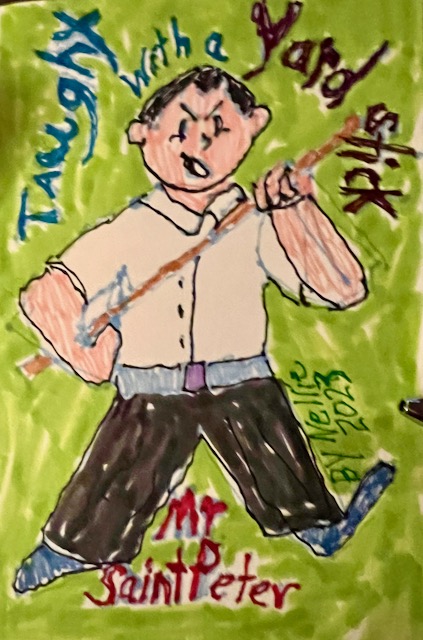
By Nellie Curtiss …
At five foot ten inches and 200 pounds, he stood like a drill sergeant in the 1964 Gomer Pyle USMC tv series or like in the 1995 movie Major Payne or any number of comedic and realistic military film fauna.
We were fifth graders at the Lindsey Air Force Base elementary school, and he, built like a football player, looked like he could whip us up and spit us out.
In civilian civies and missing the combat kakis, Mr. Saint Peter stood at attention in the front of the class with the chalk board behind him. From his backside, he pulled that wooden yard stick out, banged it on his metal desk, and commanded: “Pay attention!”
I don’t remember the lessons from that year, but I remember how he wielded his yardstick of education and how his voice rattled the young charges in his classroom. If a student’s attention waned, out came the yardstick that slammed on each student’s wooden desk. If the shell-shocked student, boy or girl, was passing a note or crumpling paper for a spit ball, the yardstick slammed across their digits on the desk. He believed that he was the punisher: Don’t dare to pull the hand away because he was contracted to cause pain.
The same year that The Fab Four (aka The Beatles) visited the tarmac at the air base, I (like other girls) wore my hair in a ponytail which was waving target for Mr. Saint Peter to pull. I remember how he would grab my ponytail and yank. It was usually when I was gazing out the picture window to the inviting grassy bank outside. Immediately, I was brought back from my thought vacation to stutter over the answer: Who was the president before Abraham Lincoln?
If he didn’t have his wooden yardstick, he improvised with a wooden 12-inch ruler. He marched between the rows and down one aisle then up the other side. Sometimes his yardstick caught a student off-guard from behind without warning. When he stood front and center, students could predict who would win his yardstick yelp.
Unlike in today’s elementary class where flogging is not allowed, Mr. Saint Peter believed the medieval adage that discipline meant bursts of brawn or “spare the rod, spoil the child”—a quote from Samuel Butler (1612-1680). (See Gutenberg.org)
Children found reprieve from the bully at the chalkboard when recess was called, or the lunchtime bell rang. Handstands, cartwheels, or relay races took our brains to healthier happier places. Swinging on the playsets and tossing jacks on the sidewalk were a time-out of range of the yardstick.
Field trips were another way to leave behind his lecture style and replace it with hands-on learning. Seeing the Gutenberg Museum with the Gutenberg Press and its antique wood were inspiring to me. I remember the delicate pages of the Gutenberg Bible encased in glass—one of the first Bibles ever printed. In the nature and science museum, we also saw ancient animals and habitats. Coming face to face with an extinct but taxidermized grouse, behind the display that is, impacted my love of wildlife and nature. I prefer wild animals in their natural settings, not glassed and mounted.
Still, Mr. Saint Peter stood like that villainous character in children’s books or like the severe Miss Trunchbull in Mathilda. Gratefully, this practice is no longer part of our more compassionate and science-based educational repertoire.
— Nelda Curtiss is a retired college educator and long-time local columnist. Reach her at http://www.columnsbynellie.com or email her at columnsbynellie@gmail.com
 Columns by nellie