By Nellie Curtiss …
Over a century ago the Maddux family crossed over Mosca pass in the dead of winter and somehow completed the journey to the Valley, setting up camp on the northside of the Rio Grande, now North River Road. The descendants of James T. Maddux (some four generations) unveiled the historical monument Saturday, Sept. 30, 2000 west of Splashland and west of the Jones family compound on County Road 8S.
(Note to reader: After the ceremony, I sat down with Jones to get the scoop for the Tuesday edition of the Valley Courier, October 3, 2000.)
“Just because I built it, doesn’t mean it’s mine. I’m leaving it to history,” said Lloyd Jones, the grandson of Maddux.
The dream child of Jones and his cousins Roy and Ray Maddux, the monument is dedicated to all who drove that road from the pony express riders to the stagecoach horses and handlers.
When James T. Maddux, family, wagons and some 40 head of cattle crested Mosca pass in 1864 ‘in a heck of a storm,” he had to turn back to Greenhorn where he drilled an artesian well.
When the family made its way to the Cottonwoods on the Rio Grande, Maddux knew he could drill a well from his experience at Greenhorn.
Concerned with preserving the Valley’s history, Jones has also marked the Valley’s first artesian well that his grandpa tapped by turning a heavy “pipe wrench.”
Even the Ute Indians traded at the Maddux store; and when the seven cabins were first erected, the Indians would raid them at night, so said Jones. The family hunkered down in ditches with only their blankets and let the Indians take what they wanted from the cabins. The family didn’t mind; they still had their lives, Jones said.
Soon, though, the Utes learned the art of trading and asking for food. The settlers knew if they didn’t give the Indians the meat they asked for that they’d just abscond with cattle.
The monument celebrates the first settlement of Alamosa, originally Wayside.
As Canadian Geese flew South and mule deer grazed in the Rio Grande meadow, City Council members Joseph Lucero, Ron Green, and others were there with Jones as he poured water over the monument to wet the stone. He hasn’t sealed it yet, he said.
The stones for the historical marker were harvested from the mountains where Jones–along with Roy, Ray, and Jean Maddux–climbed and dug for the rocks. Jones says there’s even a moon rock amongst them.
The commemoration cost $1500 but some work and supplies were donated; and the final cost of the monument was $1150. Jones admits that he didn’t do it alone. He says the Council had the foresight, Den Pak helped, and his family welcomed the preservation, too.
The plaque stands just a few feet from the original scale that weighed the coach as it stopped by Wayside for meals, fresh water, and some company. Jones says the coach would “swing up from the meadow” where the Rio Grande banks Cole Park, now. It would park its coach and horses in the now fallen barn; and mail would be delivered at the first post office in the Valley, one of the seven original cabins.
“You used to be able to see the coach tracks,” Roy Maddux said. The tracks of those stagecoach wheels and horse hooves are buried underneath the levee that breaks through the meadow now.
What’s left now of the seven cabins is Jones’ grandmother’s birthplace. It is a small cabin, original dirt floor, hooks for coats, cubby holes for supplies.
Wayside was Alamosa’s first homestead; and Maddux had the drive and vision to put Alamosa on the Rio Grande before there was a useable bridge. Some settlers ventured into the Rio Grande with their covered wagons, oxen, mules, but then would get bogged down. Crossing the river was too difficult unless done at Del Norte where there were rocks, Jones said.
At one time, a steamboat was built but that didn’t work either, because it blew up, he said.
Maddux constructed the first artesian well in the Valley, first post office, the first general store, and the first scale for the Valley. Land for Alamosa’s first school in the city limits was also donated by the family. However, the first school was further up the road some half-dozen or dozen miles, Jean Maddux said.
Jones added, “The reason Alamosa grew so fast was that when Fort Garland was dismantled, the wood was reused for Alamosa.”
— Nelda Curtiss is a retired college educator and long-time local columnist. Reach her at columnsbynellie.com or email her at columnsbynellie@gmail.com
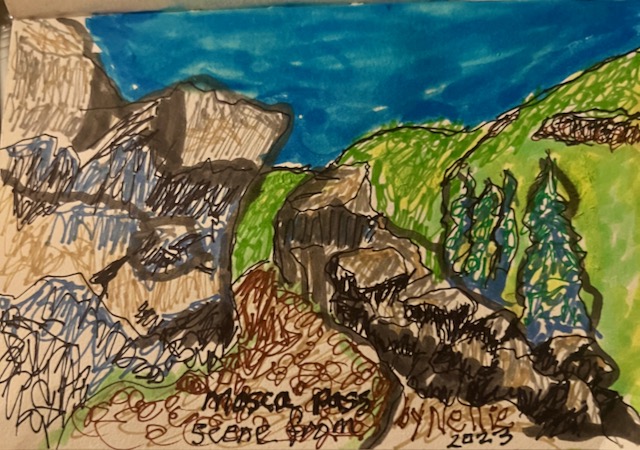
…………Cutline for picture: This colored marker drawing by Nelda Curtiss is a scene found on Mosca Pass
 Columns by nellie