By Nellie Curtiss …
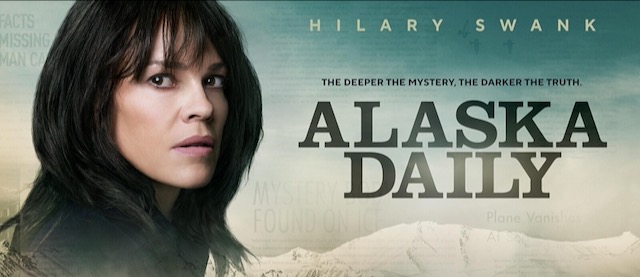
Now that you’ve early voted, maybe you’re scanning your smart TV for a good dramatic series to catch. I have one for you, Alaska Daily on ABC.
On October 19, Monique Jones of CommonSense Media wrote: “This is a powerful drama that both upholds the tenets of investigative journalism and puts the issue of missing and murdered Indigenous women (MMIW) on its largest platform yet.”
Hillary Swank, of Mexican, German, English and Scottish heritage, stars along with Grace Dove, indigenous First Nations actor, Ami Park, Korean American actor, along with Jeff Perry and Matt Maloy. Swank is also one of the Executive Producers.
The first episode introduces us to the New York award winning writer Eileen Fitzgerald (Swank). As sometimes happens to journalists, she loses her position despite her stellar and methodical journalism. Without giving too much away, she is pulled out of her recluse existence by a newsman (Perry) all the way from Anchorage, Alaska.
Near Anchorage, a missing and murdered indigenous woman’s case still has not been solved; so, Fitzgerald is pulled into the deep rotten mess in the small town. We watch as she begins her gum-shoe research on the street, door to door, and asking necessary questions of town officials. Money is involved. Sex trafficking is a variable. The officials do not offer any details. And the missing woman’s family comes forward with aspects about the missing woman’s life and dreams. The council and police have let the issue drop and are not pursuing answers to the woman’s disappearance. So, we see Fitzgerald and Rosalind “Roz” Friendly (Dove) paired up as a team.
One of the daily’s reporters in an interview on another assignment asks a candidate: Why are you running for Senate? – The candidate answers: A desire to make the world a better place. Reporter: That’s not very specific. Give me one example of what you mean? Then the candidate leaves abruptly. The reporter reassess and learns what pulled the candidate out of their interview. As the story unfolds, he kept asking questions until he uncovered the hidden details.
Running throughout the episode of Alaska Daily is a how to find the truth, the facts that tell the story. They also seek out both sides of the issues. By doing so, the writers are reinforcing fairness in reporting.
As the episode returns to the missing young woman, the two reporters are listening to the mother’s side. Then they request the public record, the police report. Though the police chief rambles about small talk and dismisses the indigenous reporter, the two women reporters are not deterred. They follow the chief. Part of how the two reporters collaborate is by asking each other why would someone hide a report?
Who, what, when, where, why, and how are the questions that ride along in every reporters brain as facts to a story are tracked down. This series continues this spark of wondering how this murder could happen.
Broadcaster Jim Lehrer was the executive director and news anchor for PBS before he passed. “In a 1997 report by The Aspen Institute, Lehrer outlined the guidelines he adhered to in practicing journalism.” He would not lie or create fake news by making up quotes. He believed in innocence until proven guilty. Anonymous sources were not used except in extreme circumstances. He would not broadcast profanity or violence; and believed even when the reporter could not be completely objective, fairness could still be achieved. He strongly believed reporting wasn’t entertainment.
This show is needed at this moment in 2022 and seems to epitomize this quote from John Dickerson, American journalist and CBS news reporter and anchor: “One of the roles of the press is to make sure that the president, in the voice of the people, is telling the truth.”
— Nelda Curtiss is a retired college educator and long-time local columnist. Reach her at http://www.columnsbynellie.com or email her at columnsbynellie@gmail.com
 Columns by nellie
What an excellent article, Nellie! And it feels like we’re all preaching to the choir these days. It’s so difficult- and getting more so each day – to break through to those that really need to hear, understand and embrace information like this.
Michele
>
LikeLike
It is a challenge, isn’t it. I am personally so glad that you liked the column. We are doing our best to move forward.
LikeLike